Low Latency Streaming

Sub-Second Streaming for Real-Time Events

When milliseconds matter — live auctions, sports broadcasts, trading floors, interactive Q&A, and real-time gaming — standard streaming is too slow. Our low latency infrastructure delivers broadcast-quality video with sub-second glass-to-glass delay using SRT, WebRTC, and bonded 5G connectivity.
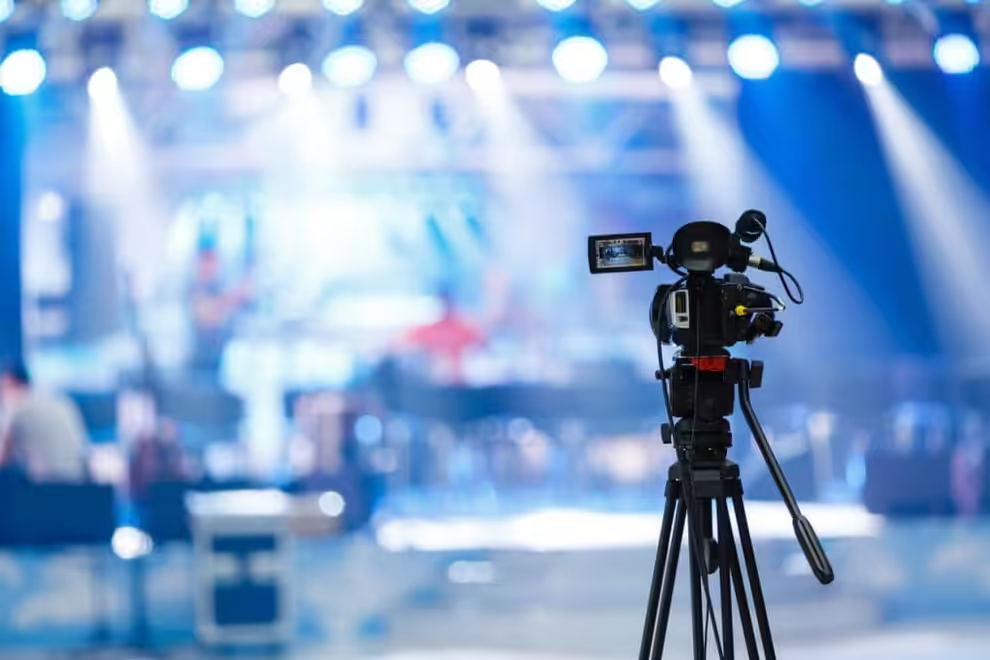
Low Latency Live Streaming Production Setup
<1s
Glass-to-Glass
SRT
Protocol
Bonded 5G
Redundancy

Services: Low Latency Streaming

IRENA ClientEarth EXOS United Nations COP28 COP27 Google Facebook IRENA ClientEarth EXOS United Nations COP28 COP27 Google Facebook
The Challenge

Standard Streaming Has a 15–30 Second Delay

Most live streams run on HLS with a 15–30 second delay between reality and what the viewer sees. That is fine for a keynote — but it is unusable for live auctions, sports betting, interactive polls, real-time Q&A, or any scenario where the audience needs to react in the moment. Standard streaming turns real-time events into time-delayed recordings.

15–30 Second Lag
Standard HLS/DASH streaming buffers in chunks. By the time your viewer sees the winning bid, the auction has already moved on.
Broken Interactivity
Live Q&A, polls, and audience reactions are meaningless when the audience is 20 seconds behind the speaker. The conversation is out of sync.
Spoiler Risk
Social media moves faster than your stream. Sports results, auction outcomes, and announcements leak before delayed viewers see them live.

Stream Live to Any Platform

We deliver professional live streams to all major platforms simultaneously

Perfect For

Who Needs Low Latency Streaming?

Live Auctions & Trading
Real-time bidding where a one-second delay means missed bids. Art auctions, charity galas, commodity trading, and live sales events.
Sports Broadcasting
Live sports where viewers need to see the action in real time — not 20 seconds after it happened on social media.
Esports & Gaming
Competitive gaming where sub-second delivery prevents stream sniping and keeps audiences synchronized with the action.
Interactive Q&A & Polling
Town halls, conferences, and webinars where audience questions and poll results need to sync with the live speaker in real time.
Live Commerce & Flash Sales
Product drops and limited-stock sales where the buy button must sync with the product reveal — not arrive 15 seconds later.
Remote Education & Training
Live demonstrations, surgical training, and hands-on workshops where instructors need real-time student feedback.
Our Solution

Sub-Second Delivery With Broadcast Quality

The right protocol for every latency requirement — engineered for reliability

SRT (Secure Reliable Transport)
Our primary low latency protocol. SRT delivers broadcast-quality video over unpredictable networks with built-in encryption, error correction, and sub-second latency. It recovers lost packets in real time — so your stream stays clean even on congested or unstable connections.
Bonded 5G + Starlink Redundancy
Multiple cellular SIMs, Starlink satellite, and venue WiFi bonded through LiveU hardware. If any single path fails, the others carry the stream instantly. Zero-interruption delivery from any location in the UAE and GCC.
MCR-Backed Encoding & Processing
Your feed routes through our Master Control Room where lower thirds, graphics, and branding are applied before distribution. Redundant encoders with automatic failover ensure zero dropped frames — even during protocol switching.
Protocol-Matched Delivery
We select the optimal protocol for your use case: SRT for contribution feeds, RTMP/RTMPS for platform compatibility, HLS for scalable delivery to large audiences, and WebRTC for true sub-second interactive experiences. Every stream is configured to match your latency and scale requirements.
Technical Specifications

Low Latency Capabilities

<1s
Glass-to-Glass
SRT
Primary Protocol
Bonded
5G + Satellite
4K HDR
Max Output
How It Works

From Camera to Screen in Under One Second

1
Consultation & Protocol Strategy
We assess your event — audience size, interactivity requirements, platform targets, and acceptable latency window. A custom protocol stack is designed: SRT for contribution, WebRTC or LL-HLS for distribution, with failover paths defined for every stage of the pipeline.
2
Technical Planning & Connectivity Setup
We assess venue requirements — camera positions, audio sources, lighting, and internet connectivity. Bonded 5G with Starlink backup is configured for redundancy. Redundant encoders are provisioned and tested. Every connection path is load-tested under simulated peak conditions before event day.
3
Live Execution & Real-Time Monitoring
On show day, our crew manages multi-camera production, vision mixing, audio mixing, and real-time directing. Our MCR team monitors latency, bitrate, packet loss, and encoder health in real time — with instant failover if any metric degrades. Your audience receives seamless, sub-second delivery from start to finish.
4
Multi-Platform Distribution & Post-Event
Your low latency feed is simultaneously distributed to YouTube, LinkedIn, Facebook, Twitch, and private CDNs — each encoded at the optimal bitrate and protocol for that platform. Post-event, ISO recordings from every camera angle and a full performance report (latency metrics, uptime, viewer data) are delivered within 48 hours.

Our Process

From discovery to delivery, we handle every detail

01

Discovery

Understanding your goals

02

Pre-Production

Graphics & planning

03

Setup

Equipment & rehearsal

04

Live Production

Broadcast execution

05

Delivery

Recordings & analytics

FAQ
What is the difference between SRT, RTMP, and HLS?
+
SRT (Secure Reliable Transport) delivers low latency video with built-in encryption and error correction — ideal for contribution feeds over unpredictable networks. RTMP is the legacy standard for pushing streams to platforms like YouTube and Facebook — reliable but higher latency. HLS is designed for scalable delivery to large audiences with adaptive bitrate but carries 15–30 seconds of delay. We typically use SRT for ingest, and then transcode to the appropriate distribution protocol for each platform.
How low can the latency actually get?
+
With SRT contribution and optimized encoding, we achieve sub-one-second glass-to-glass latency for direct feeds. For platform delivery (YouTube, Twitch), the platform's own processing adds latency — typically 2–5 seconds with low latency mode enabled. For true sub-second delivery to viewers, we use WebRTC or custom player infrastructure. We will recommend the right approach based on your acceptable latency window.
Does low latency streaming reduce video quality?
+
No. SRT maintains full broadcast quality at low latency — that is its core advantage over older protocols. We stream at up to 4K HDR with professional bitrates. The quality tradeoff only happens with consumer tools that reduce resolution to cut latency. Our broadcast-grade encoders and bonded connectivity deliver both low latency and high quality simultaneously.
What happens if the internet connection drops during a low latency stream?
+
Our bonded connectivity setup combines multiple 5G SIMs, Starlink satellite, and venue WiFi through LiveU hardware. If any single path drops, the remaining paths carry the stream with zero interruption. SRT's built-in error correction also recovers lost packets in real time, so minor network instability does not affect the viewer experience.
Can you stream low latency to multiple platforms at once?
+
Yes. We ingest via SRT at sub-second latency and then transcode and distribute to YouTube, LinkedIn, Facebook, Twitch, and custom CDNs simultaneously. Each platform receives an individually optimized feed. The contribution path stays low latency; the distribution path is optimized per platform's capabilities.
Do you support low latency streaming from remote or outdoor locations?
+
Yes. Our bonded 5G + Starlink setup works anywhere in the UAE and across the GCC. Desert events, coastal venues, outdoor festivals — we deploy venue-independent connectivity that maintains low latency even in locations with zero fixed infrastructure. The Starlink Mini weighs under 1kg and deploys in minutes.

Need Sub-Second Live Streaming?

Tell us about your event and latency requirements — we will design a protocol stack, connectivity plan, and full production setup tailored to your needs.