







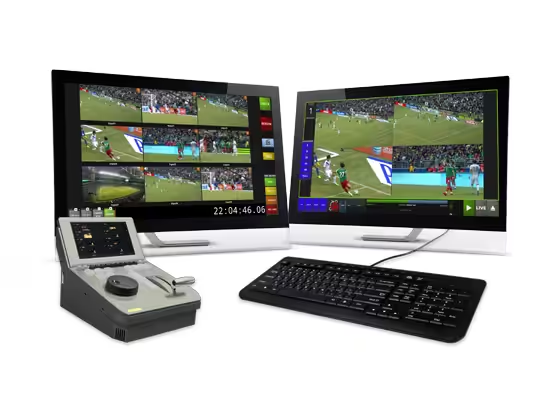
Every major moment in live sport — the disputed goal, the last-second three-pointer, the photo-finish sprint — depends on one thing behind the scenes: the replay system. It is the backbone of modern sports broadcasting, and the technology behind it has evolved far beyond simple slow-motion playback.
Today’s replay servers handle multi-camera ingest, real-time content management, highlight packaging, and automated playout — all from a single platform. Combined with IP-based broadcast infrastructure like SMPTE 2110, these systems are transforming how live content is captured, managed, and delivered to air. In the Middle East and GCC, broadcasters and esports organisers are deploying them not just for traditional sports, but for gaming tournaments, government summits, and live entertainment.
This article breaks down how live sports replay systems work, the platforms that dominate the market, and how they are being used in the region right now.
What Is a Live Replay System?
A live replay system captures multiple camera feeds simultaneously and stores them on high-speed servers. An operator can then instantly recall any angle, play it back at full speed or slow motion, and send it to air — all within seconds of the live moment.
But modern systems do much more than slow-motion playback. They function as complete production servers that handle ingest, content management, highlight creation, and scheduled playout. In a master control room (MCR), a single replay server can replace several standalone devices.
The operator works with a dedicated hardware controller — typically a panel with a jog wheel, T-bar, and shortcut buttons — combined with a touchscreen interface for searching, tagging, and building playlists. The entire multicam workflow runs through the replay system, from initial capture to final playout.
Evertz DreamCatcher — More Than a Replay Machine
The Evertz DreamCatcher has become one of the most significant replay and production server platforms in broadcast. Built on Evertz’s IP-native architecture, it runs on the Live MediaCore hardware and scales from a single-operator flypack to a full MCR installation.
What sets DreamCatcher apart is its multi-role capability. A single platform handles:
- Ingest and capture — record all camera feeds simultaneously across SDI, SMPTE ST 2110, SRT, NDI, and IP streams, in formats from HD through to 4K HDR and even 8K
- Instant replay and slow motion — frame-accurate playback with variable speed control for live sports production
- Content management — tag, search, organise, and retrieve clips in real time, replacing standalone MAM systems in many workflows
- Live edit — build highlight packages and quick-turnaround edits without leaving the platform
- Production playout — schedule and automate clip playout, acting as a channel-in-a-box for MCR environments
- Video and audio mixing — built-in mixing for production workflows
The platform connects to third-party systems including Avid Interplay, Adobe, StorNext, and Amazon S3. Its scheduler module handles automated ingest, clipping, highlight creation, and MOS integration — making it a genuine automation tool, not just a replay server.
DreamCatcher is deployed globally by broadcasters including CNN, Fox, NBC, ESPN, DAZN, Globo, and Warner Bros. Discovery. In the Middle East, clients include Ooredoo, Sharjah TV, and Al Rayyan — and it is increasingly the platform of choice for regional sports and entertainment production.
Why DreamCatcher Works for Esports
Esports production has adopted DreamCatcher at scale, and the reason is practical: the operator interface mirrors the workflow that EVS-trained operators already know.
In traditional broadcast, EVS operators spend years mastering the XT and XS series. When esports tournaments need replay operators for a three-month season — like the Esports World Cup in Riyadh — finding EVS-certified freelancers at that scale is difficult and expensive.
DreamCatcher solves this. Any operator familiar with EVS workflows can pick up a DreamCatcher controller and be productive within hours. The jog wheel, T-bar, and clip-building logic are intuitive for anyone who has worked on an EVS panel. This pick-up-and-play approach makes it ideal for esports, where production teams are assembled quickly and events run on tight timelines.
At the same time, DreamCatcher’s IP-native architecture — with SMPTE 2110 and SRT support — fits the modern esports production model where signals are routed over IP networks rather than traditional SDI infrastructure.
MCR Use: Content Management, Ingest, and Automation
In master control rooms across the Middle East, DreamCatcher is being deployed as more than a replay machine. Broadcasters are using it as a combined ingest server, content management system, and automated playout engine.
A traditional MCR might require separate systems for ingest, replay, content storage, and playout scheduling. DreamCatcher consolidates these into a single platform. Its scheduler can automate the entire content pipeline: ingest live feeds, create clips based on predefined rules, build highlight packages, and play them out to air on a timed schedule.
This is particularly valuable for broadcasters covering multiple simultaneous events — a scenario common in the region during tournament seasons, religious programming, or multi-venue conference coverage. Instead of staffing separate ingest and playout operators, one DreamCatcher installation handles both, with content management sitting in between.
The integration with enterprise storage (Avid Interplay, StorNext, Amazon S3) means content flows from the live production server straight into the broadcaster’s archive without manual file transfers.
The Competition: EVS, Grass Valley, and NewTek
DreamCatcher does not operate in a vacuum. The replay server market has several established players, each with strengths in different areas.
EVS XT and XS Series — EVS is the legacy leader in live replay. The XT series has been the standard in premium sports broadcasting for over two decades, and you will find EVS systems in virtually every major OB truck and sports venue worldwide. EVS offers unmatched reliability and the deepest pool of trained operators. The trade-off is cost — both in hardware and in the specialised operators required to run it. For large-scale, long-running broadcast operations, EVS remains the benchmark.
Grass Valley K-Frame / LDX — Grass Valley approaches replay as part of a broader production ecosystem. Their systems integrate tightly with Grass Valley switchers and camera systems. If your entire production chain is Grass Valley, the workflow is seamless. However, as a standalone replay solution, it is less commonly deployed than EVS or DreamCatcher.
NewTek 3Play — The entry point for live sports replay systems. NewTek 3Play is popular in lower-budget productions, university sports, and smaller esports events. It runs on standard PC hardware, is affordable, and has a short learning curve. The limitation is scale — 3Play handles fewer inputs and lacks the enterprise integration, IP-native architecture, and automation features of DreamCatcher or EVS.
Slomo.tv — A cost-effective alternative used in mid-tier sports production. Slomo.tv offers capable slow-motion replay with a competitive price point, but lacks the content management and MCR automation capabilities of the bigger platforms.
How We Use Replay Systems at Creative Broadcast Agency
At Creative Broadcast Agency, we deploy replay systems for live event streaming, esports, and entertainment production across the GCC.
During the Esports World Cup in Riyadh, our team operated replay systems across five arenas over three months of continuous production. The ability to onboard operators quickly — without months of platform-specific training — was essential at that scale.
For corporate and conference production, we use replay workflows to capture keynote presentations and panel discussions, tag key moments in real time, and deliver highlight packages to clients within hours of the event ending. This fits into our broader live HD streaming and production workflows.
Our approach is platform-agnostic. We select the replay system based on the production requirements: the number of camera inputs, the output format, the integration needs, and the operator pool available. Whether it is DreamCatcher, EVS, or a lightweight 3Play setup for a smaller event, the goal is the same — frame-accurate, reliable playback that serves the live production. For more on where replay technology is heading, see our article on the future of replay in sports and IP replay broadcasting.
Choosing the Right Replay System
The right system depends on your production. Here is a quick comparison:
| Feature | Evertz DreamCatcher | EVS XT/XS | NewTek 3Play | Slomo.tv |
|---|---|---|---|---|
| Best for | MCR, esports, multi-role | Premium sports broadcast | Small events, university | Mid-tier sports |
| Max inputs | 48+ (scalable nodes) | Up to 24 (XT-VIA) | 8 | 12 |
| IP native (SMPTE 2110) | Yes | Yes (XT-VIA) | No | No |
| Content management | Built-in | Via third-party (IPDirector) | Basic | Basic |
| Automation/scheduling | Yes (Scheduler module) | Via third-party | No | No |
| Operator learning curve | Low (EVS-familiar) | High (specialised) | Low | Medium |
| Price point | Mid-high | High | Low | Low-mid |
FAQ
What is the best replay system for live sports? It depends on the scale. For premium sports broadcasting with large budgets and dedicated operators, EVS remains the industry standard. For multi-role production environments, esports, and MCR deployments, Evertz DreamCatcher offers more flexibility at a lower total cost.
Can DreamCatcher replace EVS? In many workflows, yes. DreamCatcher handles the same core functions — ingest, replay, slow motion, and playout — while adding content management and automation. The operator interface is familiar to EVS-trained operators, making the transition straightforward.
What replay systems are used in esports? Esports productions commonly use Evertz DreamCatcher, EVS XT, and NewTek 3Play. DreamCatcher is increasingly preferred for large tournaments due to its ease of onboarding operators and IP-native architecture.
What is SMPTE 2110 and why does it matter for replay? SMPTE 2110 is an IP-based broadcast standard that transports video, audio, and metadata as separate streams over standard network infrastructure. Replay systems that support 2110 — like DreamCatcher and EVS XT-VIA — can connect directly to IP-based production networks without SDI converters.
How do replay operators work during a live broadcast? The operator monitors all camera feeds simultaneously, marks key moments with in and out points, and builds playlists of clips. When the director calls for a replay, the operator plays the selected clip to air at the chosen speed — from real-time down to super slow motion — typically within seconds of the live moment.
Does Creative Broadcast Agency provide replay systems for events? Yes. We deploy replay systems for live sports, esports, corporate events, and entertainment production across the UAE and GCC. Contact us for a production quote.